

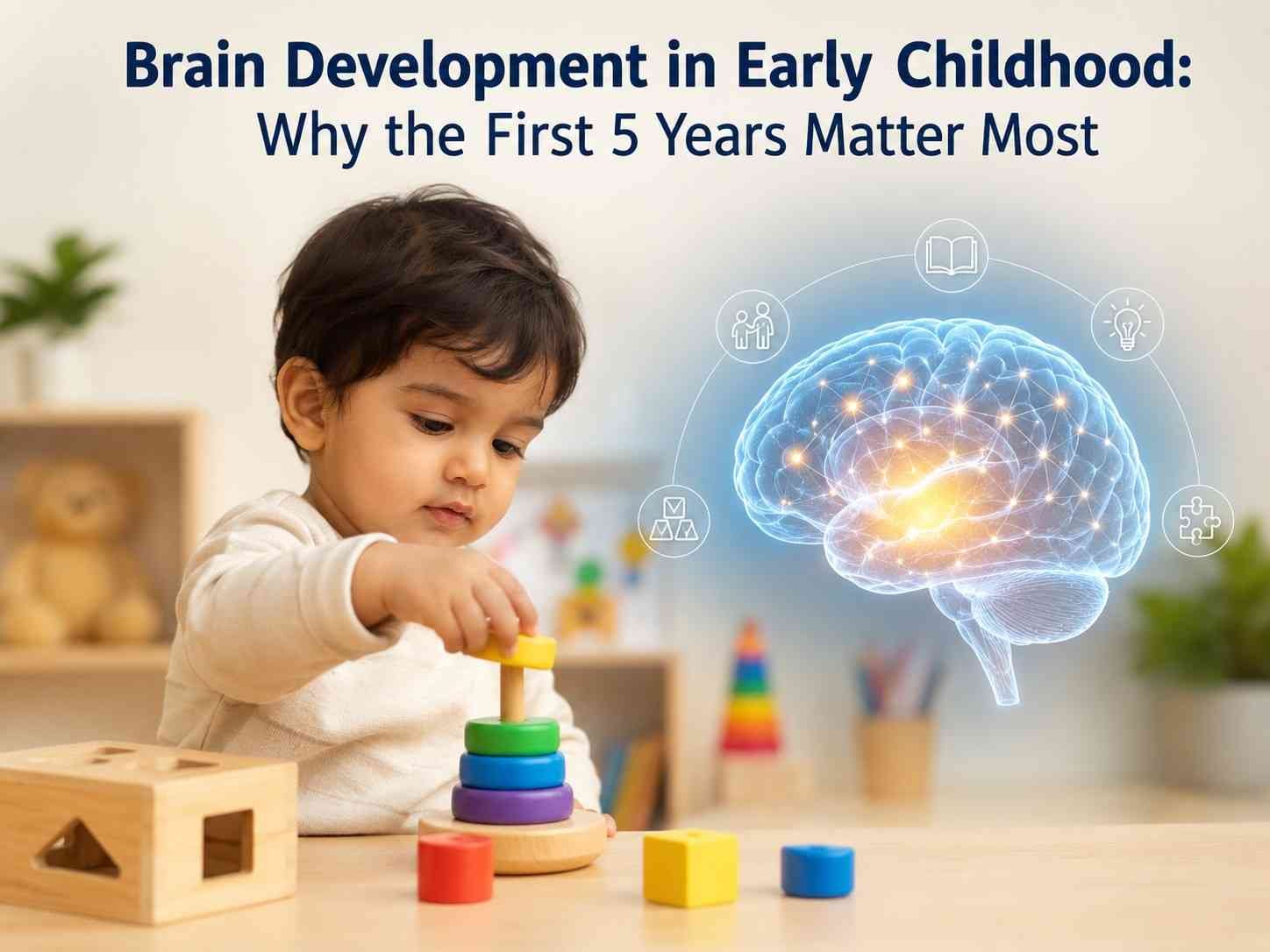
Have you ever wondered about the rationale behind the importance attributed to the first five years in life by experts in this regard? How much does brain development in the first five years influence learning, behaviour, and emotional development? All of these will go into shaping the thinking and communication skills of the child later on. At Pastels Preschool and Daycare, our experts believe that the surroundings have an important role to play in the development process. With knowledge of brain development, parents can take the right steps.
In the early years of childhood, enrolling kids in a great Kids learning centre in Dilshad Garden will lead to planned activities that develop kids socially and emotionally.
Why the First Five Years Are So Important
The brain of a child develops at an extremely fast pace in early childhood. As per the Centre on the Developing Child at Harvard University, the first few years of life see the formation of more than a million neural connections every second in the brain. This helps the development of the ability to communicate, remember, regulate emotions, and solve problems.
Rapid brain development is responsible for the fact that children can learn at a pace much higher than at any other time in their lives. Responsive care, play activities, reading, music, and social interactions help enhance the formation of neural connections.
Parents who are searching for a pre-nursery school in Dilshad Garden generally prefer an environment that helps in exploration and creative interaction, as this contributes greatly to the development process.
Brain development stages by age
Knowledge of the stages of brain development according to age enables parents to provide learning experiences for their child based on his or her level of ability.
Birth to 12 Months
- Recognises familiar faces and voices
- Develops sensory awareness
- Begins forming emotional attachments
- Learns through observation and interaction
1 to 2 Years
- Vocabulary grows rapidly
- Curiosity increases
- Motor skills improve
- Starts understanding simple instructions
2 to 3 Years
- Develops imagination through pretend play
- Improves memory and communication
- Begin solving simple problems
- Learns basic social skills
3 to 5 Years
- Strengthens logical thinking
- Builds early literacy and numeracy skills
- Develops self-control
- Learns teamwork and cooperation
Knowledge of these brain development stages according to age enables parents and educators to present activities suited to the children’s developmental needs and not to push them academically.
Children at Pastels Preschool and Daycare are given age-appropriate activities to engage in, which help them learn while building their confidence and independence.
When is your brain fully developed?
Many parents ask, when is your brain fully developed?
The studies conducted by scientists proved that despite the presence of many changes during childhood, brain development does not stop and continues until early adulthood. According to the National Institute of Mental Health, the prefrontal cortex, which controls planning, decision-making, and impulses, develops until the mid-20s.
Awareness of the brain’s development helps us understand that the process of learning is an ongoing process. However, it should be noted that the most efficient time for future learning is the first five years, hence the value of experience.
Instead of focusing only on the achievements in the educational field, it would be better for parents to foster children’s enthusiasm to learn, communicate, create, move and feel safe.
Early Childhood Learning Builds Strong Foundations
Early childhood learning is far more than teaching children the alphabet or numbers. It helps develop communication, confidence, creativity, and independent thinking.
Effective learning during early childhood includes:
- Storytelling
- Music and movement
- Building blocks
- Outdoor exploration
- Art and creativity
- Interactive play
- Group activities
They help activate various parts of the brain while aiding the development of language skills, motor skills, and emotional intelligence among children
At Pastels Preschool and Daycare, the activities aimed at learning have been carefully crafted such that they promote exploratory behaviour rather than rote learning.
Early childhood brain development depends on Daily Experiences
A child’s brain development at this stage relies very much on day-to-day interactions between the child and adult.
Simple activities such as:
- Reading together
- Asking questions
- Singing songs
- Playing games
- Talking during meals
- Exploring nature
All strengthen neural connections that support future learning.
According to the findings from research done by the Centre for the Developing Child at Harvard University, responsive relationships and interaction have a very crucial role to play in the healthy development of the brain in children.
The ideal conditions for learning involve feeling safe and supported to explore the environment.
Importance of early childhood education
The importance of early childhood education extends beyond preparing children for school.
Quality early education helps children develop:
- Communication skills
- Emotional resilience
- Social confidence
- Critical thinking
- Creativity
- Problem-solving abilities
UNESCO studies also indicate that good early education enhances the readiness of children for schooling and contributes to improved educational achievements in the future.
The importance of early childhood education is even further highlighted when the children attend a learning environment that is well balanced between academics and play.
Factors That Support Healthy Brain Development
| Factor | How It Supports Development |
| Responsive parenting | Builds emotional security and trust |
| Healthy nutrition | Supports brain growth and energy |
| Adequate sleep | Helps memory and learning |
| Active play | Improves motor and cognitive skills |
| Reading daily | Develops language and imagination |
| Social interaction | Builds communication and empathy |
| Creative activities | Encourages problem-solving and innovation |
These daily experiences work together to create strong neural connections that benefit children throughout life.
Simple Ways Parents Can Help at Home
Parents play the most important role during early childhood.
Simple habits include:
- Reading every day
- Encouraging questions
- Limiting unnecessary screen time
- Talking during everyday routines
- Praising effort instead of perfection
- Providing opportunities for free play
- Maintaining consistent routines
All of this can be accomplished without any need for costly materials.
Conclusion
The first five years offer a unique chance to form the basis for lifelong learning and confidence. For the healthy development of the brain of the child in this period, he needs good relationships, significant experiences, proper nutrition, education and also exploration of the world in play.
If you want to know more about creating the right learning environment for your child, please feel free to contact us at Pastels Preschool and Daycare. Our experienced staff will be glad to assist your child in developing his skills and personality during those crucial years of life.
One thought on “Brain Development in Early Childhood: Why the First 5 Years Matter Most”